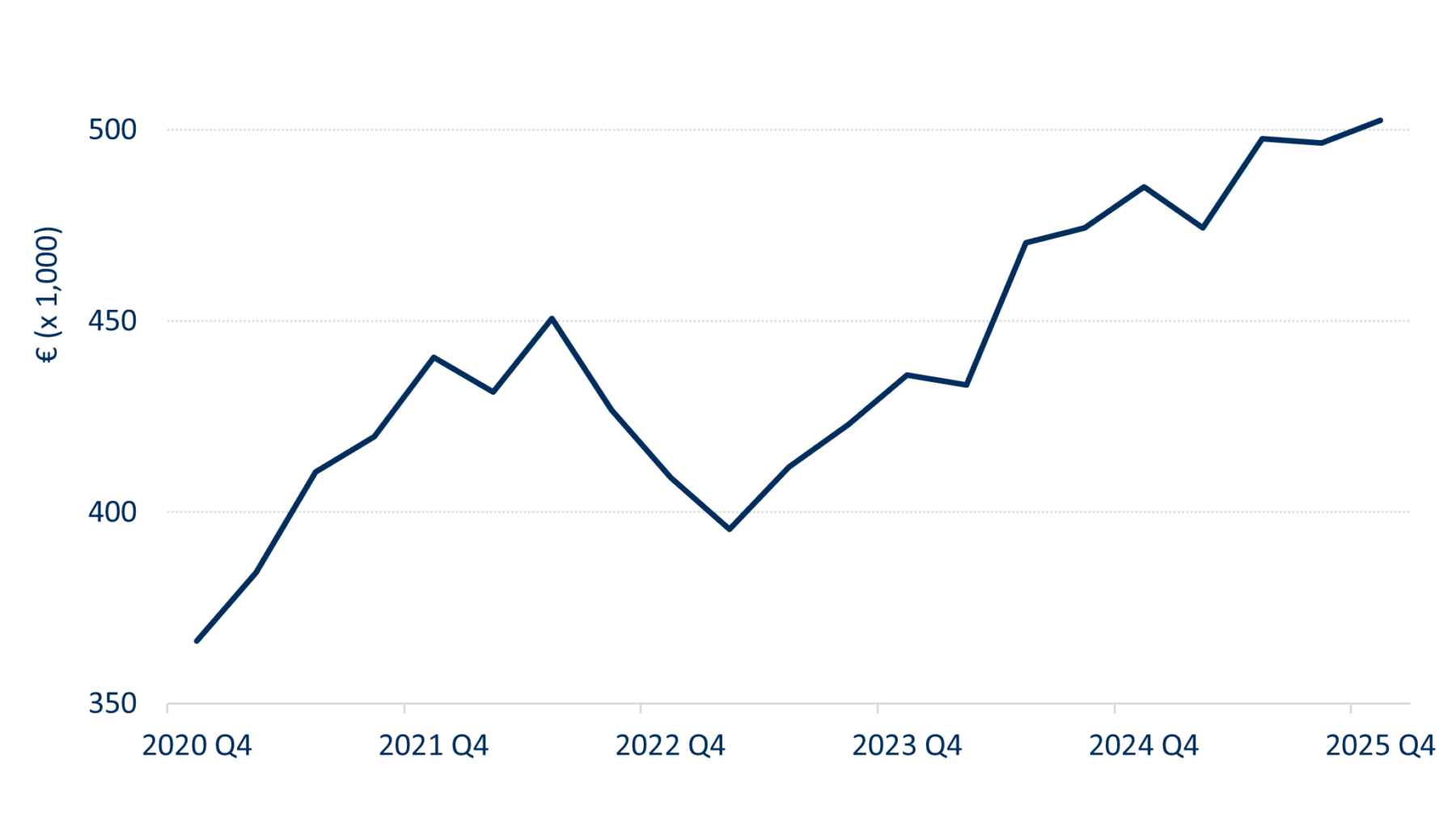
In the last quarter of 2025, we saw the average house price in the Netherlands rise above the €500,000 mark. At the same time, the supply of homes on the market increased, mainly due to the sale of investors’ rental properties (“uitponding”) and the resulting increase in the number of homes available on the market because of this. This means that the major banks ABN, ING and Rabobank predict that the rise in house prices will slow down in 2026. They expect house prices to rise by 3% to 4%, compared to around 8.6% in 2025.
Figure 1: Average House Price (residential owner-occupied)
Statistics Netherlands, DMPM
Due to the Affordable Rent Act, which was implemented in 2024, we have been seeing an increased supply in the market for some time now. In the last quarter of 2025, this is evident from the 49,500 homes that are up for sale. This increased supply is temporarily easing the market, but the structural problems (insufficient housing supply and affordability of homes) remain. However, we are seeing a slight decline in overbidding and homes are selling less quickly.
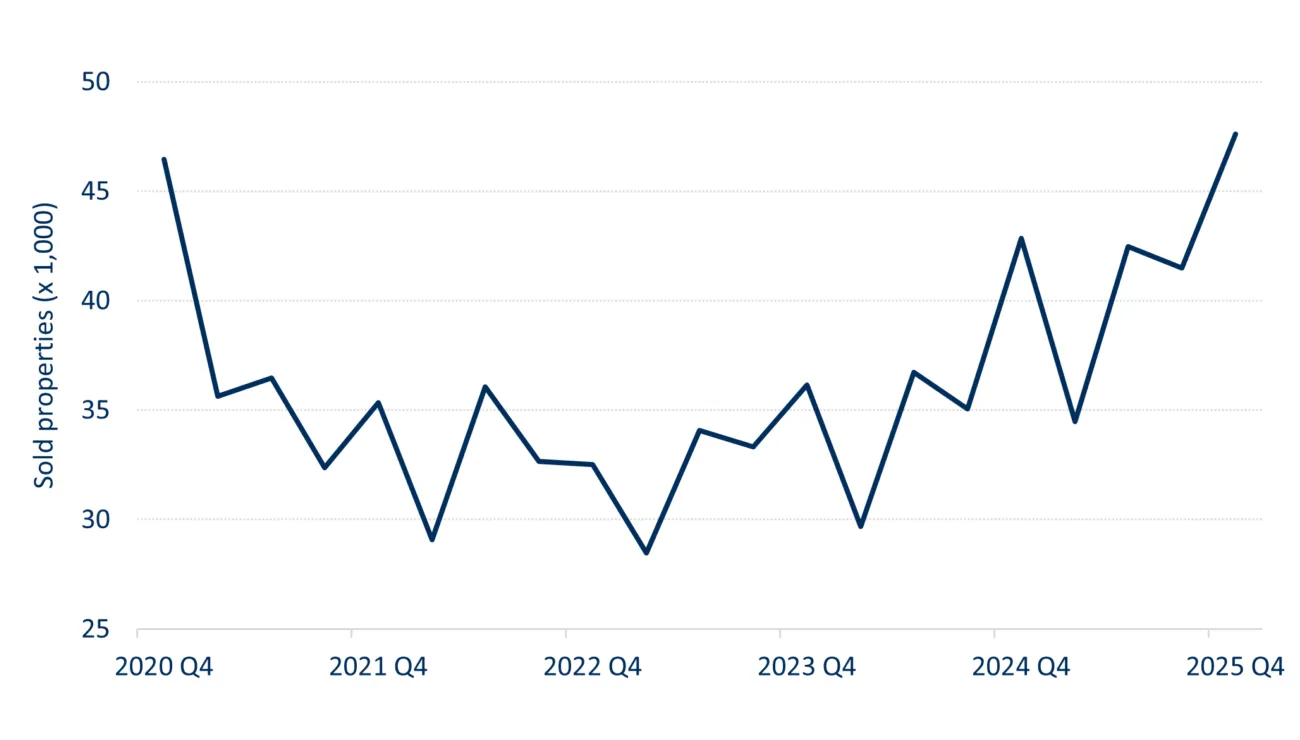
NVM estate agents sold 47,600 homes in Q4 of 2025. Only in the record period of 2016, more homes were sold in a single quarter. Many of these sales are to firsttime buyers, who purchase the relatively inexpensive homes that are being offered for sale due to uitponding. As indicated in previous quarterly reports, changing legislation has made it less attractive and profitable to hold on to and rent out an extra home, which is why these houses are increasingly being offered for sale on the market.
Initially, it was private individuals who sold their second homes, but in 2025 we also saw professional investors start selling their properties
Figure 2: Number of Houses Sold
NVM
The above development provides some relief in the market, but the structural problems remain. For years, the Dutch government has had the ambition to build 100,000 new homes per year. This number is necessary to ensure that supply and demand in the market are balanced and that the unrest in the market decreases. The goal is to have this plan fully realised by 2050 and to restore calm to the market. However, we have seen that this ambition has not been achieved for years, and 2025 was no exception. With a total of 68,000 new homes built, it was even a low point. Forecasts for 2026 indicate that 80,000 to 85,000 new homes are expected to be built. Even if this target is achieved, it will not be enough to meet the growing demand for housing.
The expectation is that housing supply for the buyer’s market will still be generated in 2026 through uitponding, but that this will decline sharply thereafter. That is why the Ministry of Housing and Spatial Planning is coming up with a new plan, which means that 900,000 new homes will have to be built by 2030. The majority of these homes will be used as social housing and will therefore not be put on the market for sale, but if this plan is realised, it should bring some much-needed relief to the market. Unfortunately, in recent years we have seen that the Dutch government has great difficulty in realising new construction plans and achieving the set objectives. Since many investors have started selling their rental properties, the rental market has become tight as well. The government therefore also focuses on the rental market with the new builds in 2026.
In our previous quarterly reports, we discussed the Schoof cabinet, which fell in June 2025 due to disagreements over asylum and migration policy. As a result, new elections were called in 2025, with D66 and PVV both becoming the largest parties with 26 seats each. D66 ultimately received the most votes and therefore began negotiations on the formation of a new cabinet.
Last week, it was confirmed that a cabinet consisting of D66, VVD and CDA will be formed. Together, they have 66 seats (out of a total of 150) and therefore intend to form a cabinet with a large minority. They will lack a majority of votes in both the Senate and the House of Representatives, which raises the question of how much support they will be able to generate in tackling the problems surrounding the housing crisis in the Netherlands. After the formation, the first plans for the housing and mortgage market surfaced. All three parties in the cabinet take the problems in the housing market (both in the rental and owner-occupied sector) very seriously and say they will do whatever it takes to create more housing supply. This means more new build in new areas, but also expanding current neighbourhoods, adding more floors to high-rise buildings and transforming commercial spaces into residential space.
In previous quarterly reports, we discussed the government's plans to gradually phase out mortgage interest relief and eventually eliminate it altogether. The current cabinet has issued a brief statement indicating that the tax regulations surrounding owner-occupied homes will remain intact as they are now, which means that mortgage interest relief will not be further reduced for the time being.