

The evolution of interest-only mortgages in the Dutch market
The Dutch mortgage market has undergone significant transformation over the past decades, largely driven by evolving legislation and regulatory intervention. One of the most notable developments concerns the interest-only mortgage. Once highly popular among homeowners, this product has gradually been restricted and is now subject to closer scrutiny. This discussion focuses primarily on the current landscape and the prospective role of interest-only mortgages.
Although interest-only mortgages have existed since the 1980s, their widespread adoption was facilitated by favourable tax treatment and a broad range of mortgage products that did not require immediate principal repayment. From the early 2000s onwards, however, policymakers increasingly prioritised transparency and risk mitigation. This shift resulted in major reforms, including stricter rules on tax deductibility and lending conditions.
A key turning point occurred in 2013, when new regulations stipulated that mortgage interest tax relief would only apply to loans that are fully amortised within 30 years on an annuity basis. As a consequence, interest-only mortgages lost their tax advantages for new borrowers. While existing loans were exempted from the new rules, the regulatory framework fundamentally altered the attractiveness of this mortgage type.
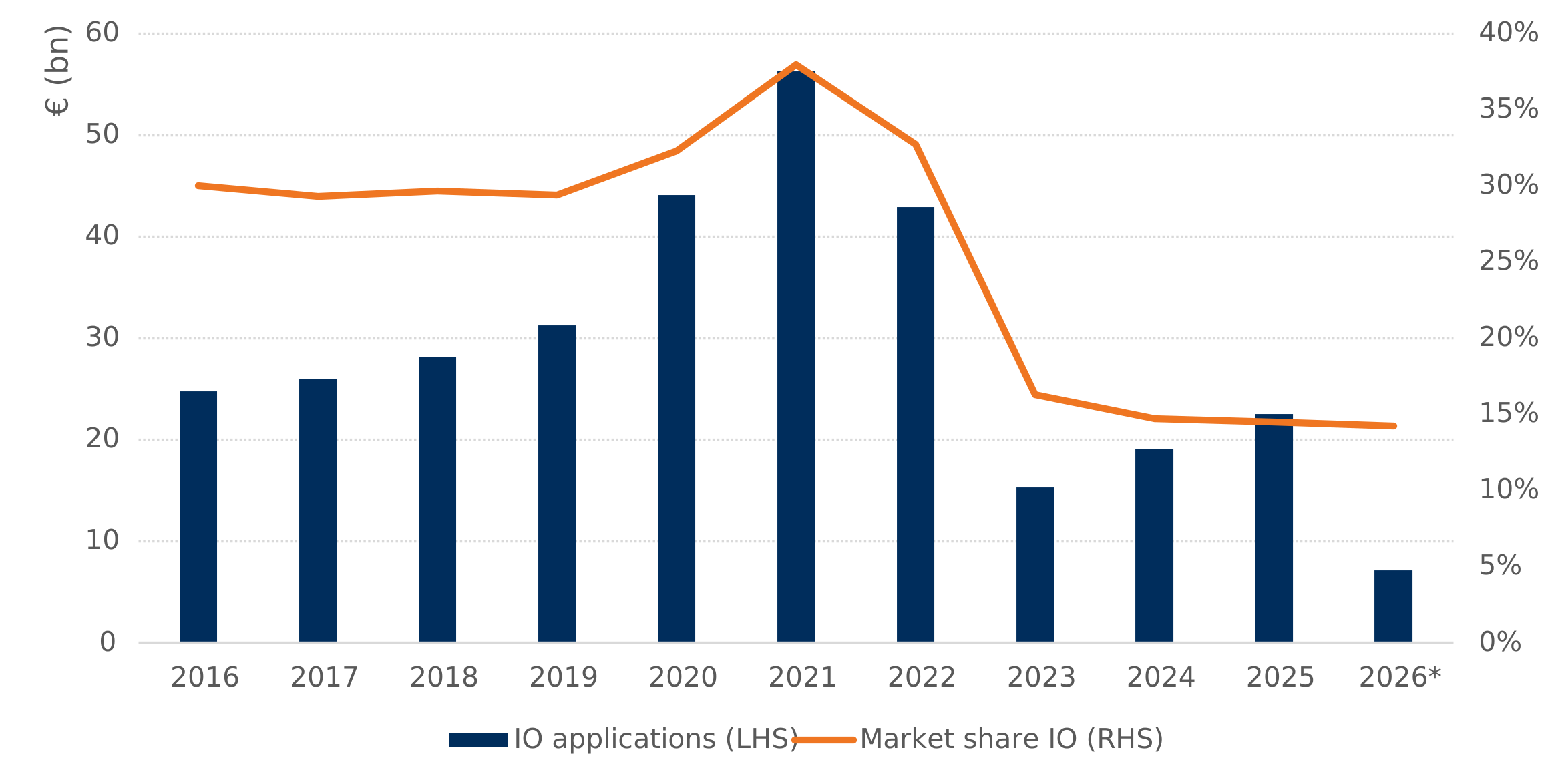
Despite these constraints, interest-only mortgages remained appealing, particularly during the period of historically low interest rates between approximately 2015 and 2022. Low monthly payments contributed to renewed demand. As of 2026, interest-only loans still represent a substantial share of approximately 45% of the total outstanding mortgage debt in the Netherlands. However, the rise in interest rates since 2022 has reduced their attractiveness and led to a decline in new originations.
Market volume interest-only applications excl. bridge loans
*2026 YTD April HDN, DMPM Analysis
Current attention is increasingly focused on the risks associated with interest-only borrowing. Supervisory authorities, including the European Central Bank (ECB) and De Nederlandsche Bank (DNB), have highlighted that the absence of regular principal repayments can result in residual debt at maturity. Borrowers must then either refinance, repay through accumulated savings, or rely on property equity.
While rising house prices in recent years have increased household equity, reliance on property valuations introduces uncertainty and potential vulnerability according to the regulator.
Moreover, regulators emphasize that households with interest-only mortgages may be more exposed to financial distress in the event of adverse income shocks, such as unemployment or disability. Since outstanding debt levels remain relatively high, repayment capacity can quickly become strained. From a prudential perspective, the ECB and DNB advocate for more proactive risk management by lenders, including efforts to gradually reduce the overall share of interest-only exposures.
In contrast, the Dutch Authority for the Financial Markets (AFM) offers a more nuanced perspective. While acknowledging the inherent risks, the AFM points out that Dutch households generally possess substantial pension assets compared to their European counterparts, providing a relatively stable income base after retirement. According to the AFM, these factors mitigate some of the risks identified by other regulators. The AFM emphasizes that effective monitoring by lenders, combined with clear and timely communication with borrowers, can substantially reduce the likelihood of adverse outcomes.

The ECB imposes new rules on Dutch banks
Despite the AFM’s position, the ECB has instructed Dutch banks to tighten their policies on interest-only mortgages and to reduce the total interest-only portion of their mortgage portfolios. Because a substantial portion of the total mortgage debt in the Netherlands currently consists of interest-only mortgages, it is unclear to banks when, how much, and indeed whether this money will be repaid at all. This reduces banks’ agility and flexibility in the event of potential economic downturns in the future. The European Central Bank (ECB) aims to mitigate this risk by gradually reducing the share of interest-only mortgages.
As a result, the first banks have already implemented changes in 2026:
- Rabobank has announced that for new mortgage applications, a maximum of 30% of the market value of the property may be interest-only. In addition, an absolute cap of €150,000 has been introduced. These rules have taken effect on 11 May.
- ABN AMRO and its subsidiary Florius have announced that for new mortgage applications, a maximum of 30% of the market value of the property may be interest-only. In addition, a cap will apply to the maximum interest-only amount for properties valued up to €1 million, the maximum interest-only portion is €150,000. The maximum interest-only portion is higher with increasing property values.
- ASN Bank and Obvion have implemented the same rules without introducing an absolute monetary cap.
Shortly after this news became public, there was uncertainty about what these changes would mean for existing customers. Questions arose regarding cases of divorce, death, portability of a mortgage, or other mortgage servicing situations. Rabobank and ABN AMRO indicated that in case of required loan adjustments as a result of life events nothing changes for existing customers and that they can retain their interest-only portion. Both parties do note, however, that when a customer makes use of the portability option, the new rules regarding interest-only mortgages will apply. At Rabobank, customers are still allowed to increase their mortgage while keeping their existing interest-only portion. This exception will run until 1 January 2030. At ABN AMRO, the new rules already apply when a customer wants to increase their mortgage.
Following these changes, there was considerable criticism from market participants expressing their concerns regarding the current development.
They criticise the banks’ communication on this matter (a study conducted by the consumer programme Radar found that 66 per cent of consumers are unaware that their bank has introduced stricter rules, while 75 per cent report never having been informed by their mortgage provider about the implications for their personal situation) and argue that the interests of the banks take precedence over those of their customer.
In addition, Van Bruggen Adviesgroep indicates that it is becoming more difficult for consumers with an interest-only mortgage to move to a new property. If a customer currently has more than 30 per cent of their mortgage on an interest-only basis and wishes to make changes that trigger the application of the new rules, both their gross and net monthly payments will increase. For existing customers who do not make any changes to their interest-only mortgage, problems may arise upon the expiry of the term. A large number of interest-only mortgages are due to mature in the periods 2035–2038 and 2047–2052. Should these customers wish to refinance at that stage, they will be required to comply with the new, more stringent criteria.
Despite these objections, the new interest-only rules will be implemented, and it is expected that more Dutch banking institutions will introduce similar policies.
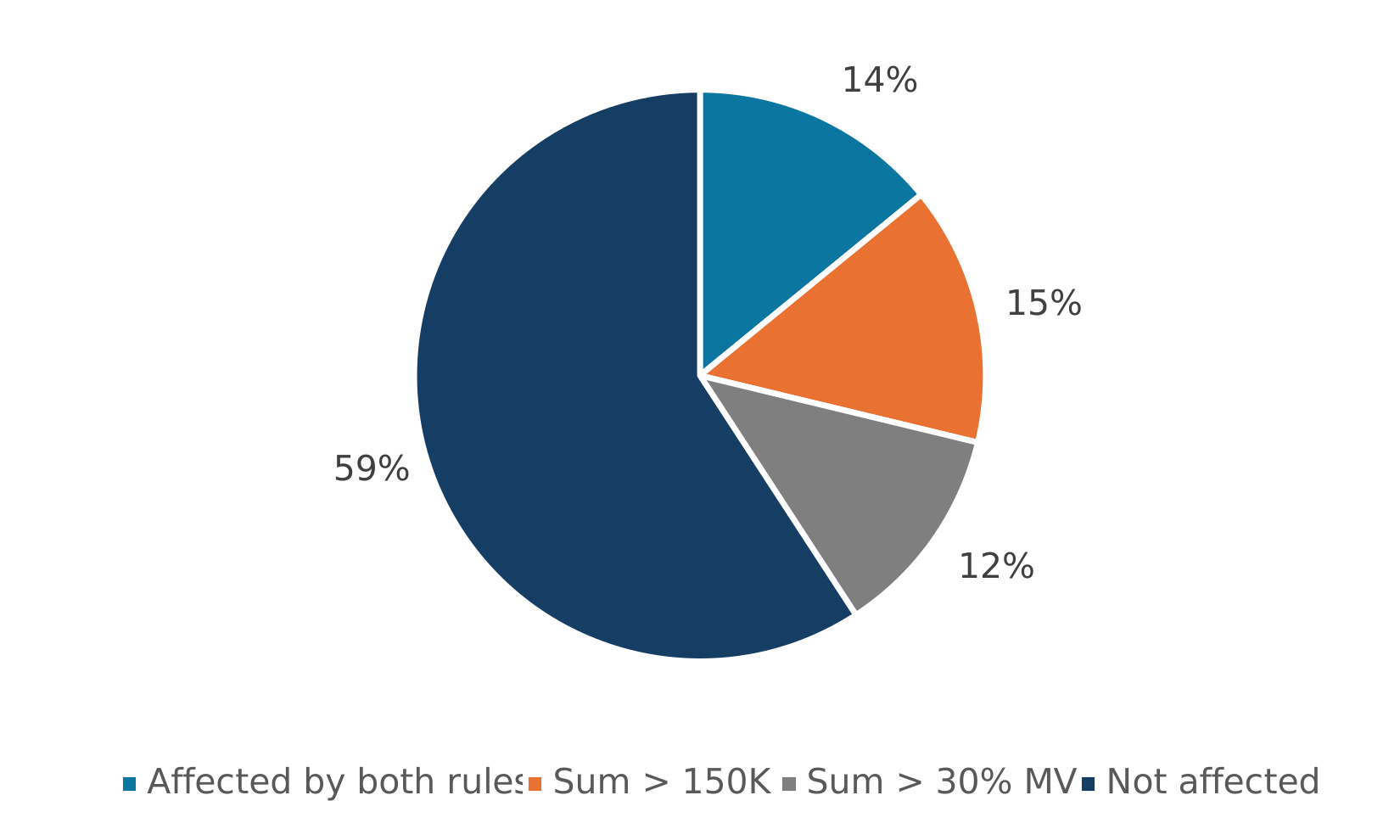
ECB rules specifically apply to banks and not to pension funds or insurers, so it is still unclear what the consequences will be for those parties. If we look at the total DMPM portfolio, we observe that 27% of the total loans breach one of the two rules, while 14% breach both (measured by outstanding balance). See the chart below.
Interest only in DMPM portfolio originated since 2016 (size)
DMPM Analysis
Impact on Dutch mortgage portfolios
The question now is what impact these developments will have on Dutch mortgage portfolios and how they will evolve with regard to interest-only lending. For new borrowers the difference is straightforward: they will have to comply with the new rules. More banks are likely to introduce stricter policies, while non-bank lenders currently still have the freedom to maintain their existing rules. As a result, the availability of interest-only mortgages may influence borrowers’ choice of lender.
For existing customers, the consequences may be significant. If they wish to move to a new property and either refinance or port their mortgage, they will be required to comply with the new rules. This may result in customers remaining in their current homes for longer. Customers who currently benefit from a low interest rate (primarily those who took out a mortgage prior to 2022) are reluctant to refinance and relinquish their favourable rate. If the increase in monthly payments, due to the reduced proportion of interest-only borrowing, constitutes too great an obstacle, these customers are likely to remain in their existing property rather than move.
There are, of course, also customers with higher interest rates who are not necessarily tied to their current mortgage terms. For them, refinancing remains a viable option. In their case, the decision will largely depend on the actions of other market participants: will they follow the policies of ABN AMRO and Rabobank, or will they also tighten their rules regarding interest-only borrowing? If the latter occurs, these customers will likewise have to contend with higher monthly payments when refinancing, as a result of a reduced interest-only component. This is likely to result in customers having fewer opportunities to refinance and therefore being less flexible in the market.
The supervisory authority AFM has (among other things) expressed concerns about this when it indicated that these measures do not place the customer’s interests at the forefront. It is also possible that further tightening of the rules regarding interest-only loans may follow in the future if the ECB is not satisfied with the reduction of such loans in the Netherlands. However, it would be premature to speculate on this here.
Customers who wish to release equity from their existing property will also face increased restrictions. At present, they are still able to withdraw this equity on an interest-only basis from Rabobank, but the new rules will apply to them as well. These customers may find themselves constrained by the new rules. If they are faced with higher monthly payments as a result of being required to repay capital, the original purpose of releasing funds is undermined. They clearly do not wish to utilise the equity in their property only to use it to service that same loan through monthly repayments. In particular, individuals who wish to release funds either to make a gift to a child or to finance expenditure during retirement prefer to do so on an interest-only basis. For them, it is not logical to repay such a loan and incur higher monthly costs. The new rules risk leaving this group without viable options.
This creates an opportunity for investors in the Netherlands to serve this segment through equity release products. If this product offers customers the opportunity to release equity from their property while maintaining as large an interest-only component as possible (for example, 70% or 80%), this target group is likely to show interest. This could give rise to a new market segment in the short term.
Finally, there are customers who wish to increase their existing mortgage. At Rabobank, these customers are currently still able to increase their loan without having to comply with the new rules, whereas at ABN AMRO they are immediately required to adjust the interest-only portion of their mortgage in line with the new criteria. If market participants align their policies with those of ABN AMRO, customers with a substantial interest-only component will be unlikely to increase their existing mortgage, particularly in cases of relatively small additional borrowing. Such increases would lead to significantly higher monthly payments, due to the increased repayment obligations on the existing loan. This is likely to discourage customers from undertaking modest additional borrowing for renovations or sustainability improvements.
While there remain sufficient alternative options for customers to finance sustainability measures through other types of products, these will require full repayment on that portion of the loan and may also necessitate adjustments to the existing mortgage. As a result, there is a risk that the pace of improving the sustainability of the Dutch housing stock may slow, and that lenders with stricter policies on interest-only borrowing may, comparatively, hold a greater proportion of properties with lower energy efficiency ratings in their portfolios.
The conclusion is that the options available to customers with an interest-only mortgage are being constrained by the newly introduced measures. It remains to be seen how other market participants will respond, but it appears evident that the remaining banks in the Netherlands are likely to introduce similar measures. This implies that the options available to customers with an interest-only mortgage in the Netherlands will become more limited. They will have fewer opportunities to port or refinance their loans. Consequently, for existing investors in the Netherlands, this is expected to lead to a decrease in the CPR, despite the additional scheduled amortisations that will take place.
Want to know more?
For questions about this publication or about our services, feel free to reach out to Roy, the author of this article.
